Joffrey Velaryon’s fatal flight
Fire & BloodJoffrey Velaryon’s fatal flight was a desperate, unauthorized attempt to intervene as a mob advanced on the Dragonpit. He mounted Syrax, his mother Rhaenyra Targaryen’s dragon, intending—according to the account’s cautious reconstruction—to reach the Dragonpit or perhaps join the fighting. Instead, Syrax resisted him in the air, and Joffrey fell to his death before reaching the hill. The episode joins a family tragedy to the wider collapse of royal control: the prince’s decision could not save the dragons, and his death brought the city’s violence into the streets around his body.
The Crisis and Joffrey’s Decision
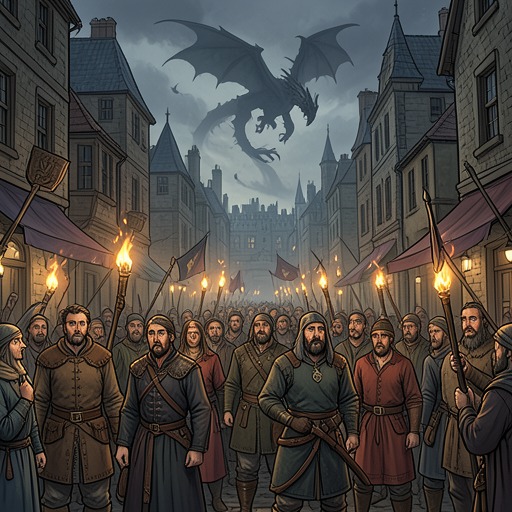
As the Shepherd’s followers marched toward the Dragonpit, Rhaenyra sent riders to the Old Gate and Dragon Gate to disperse the crowd, capture the Shepherd, and defend the royal dragons. The account stresses how uncertain the orders’ prospects were amid the city’s turmoil: it was not clear whether the riders had reached their posts, and the remaining loyal gold cloaks were too few to expect success. When Joffrey asked to ride out with the queen’s knights and men from White Harbor, Rhaenyra refused. She judged that the castle itself might be the next target and that its defenders could not be spared.
The queen’s refusal left Joffrey facing the danger from the roof, with the Dragonpit and the threatened dragons below and beyond him. The account recounts that Rhaenyra initially dismissed the approaching crowd as no match for dragonfire; Mushroom warned that a multitude could overcome even a powerful foe. The warning did not change her immediate decision to hold the castle. Only when the watchers heard Syrax roar did they notice that Joffrey was gone. Rhaenyra then called for men to pursue him and bring him back, a reversal that made clear how quickly a prince’s private action had become a crisis for the queen and her household.
Syrax and the Flight
Joffrey was familiar to Syrax by sight and scent, and his fumbling at her chains did not alarm her. But familiarity was not the same as accepting a rider: Syrax had never carried anyone but Rhaenyra. The narrative explicitly distinguishes a dragon from a horse that might be ridden by anyone able to mount it. That distinction governs the outcome. Joffrey climbed onto Syrax in haste, without a saddle or whip, and the dragon’s lack of alarm while he approached gave way to resistance once they were airborne.
The account does not present Joffrey’s precise objective as certain. It suggests that he may have meant to fly Syrax into the fighting, but considers it more likely that he intended to cross the city to the Dragonpit and reach his own dragon, Tyraxes. He may also have hoped to release other dragons kept there. These possibilities remain conjecture rather than confirmed intention. What is certain is that Joffrey never reached the Hill of Rhaenys. Syrax twisted beneath him, trying to free herself from the unfamiliar rider, while missiles thrown from below further agitated her. Joffrey lost his hold high above Flea Bottom and fell to the ground.
Death and the Attempt to Recover Him
Joffrey died from the fall. The account gives the location as a junction of five alleys in Flea Bottom and describes his descent across a steep roof before he struck the ground. It also preserves a local story that Robin, the daughter of a candlemaker, comforted him as he died, while cautioning that the tale may belong more to legend than to history. His reported final words are likewise presented as uncertain, since they might have been addressed to Rhaenyra or to the Mother Above. The narrative therefore separates the established outcome—Joffrey’s death—from details that later tellers could not verify.
The prince’s death did not end the danger surrounding him. People in the streets stripped and mutilated his body before Rhaenyra’s knights arrived; the account describes a struggle in the mud over possession of his remains. The queen’s party recovered him, but the rescue came at a heavy cost. Three of the Seven Who Rode died in the fighting: Ser Gyles Yronwood, Ser Willam Royce, and Ser Glendon Goode. Royce’s famed Valyrian sword, Lamentation, was taken and never recovered. Goode, only twenty years old and Lord Commander of the Queensguard for less than a day, was killed during the same struggle. The attempt to retrieve Joffrey thus became another battle within the city’s larger disorder.
Succession and Narrative Significance
Joffrey was Prince of Dragonstone and heir to the Iron Throne. The account identifies him as Rhaenyra’s last son by Laenor Velaryon, while noting that others could regard him as the last of her sons by Harwin Strong. That unresolved question of parentage shadows his public position without changing the stated fact of his place in the succession. His death removed Rhaenyra’s heir at a moment when the queen’s hold on the city and the safety of her dragons were both under threat.
The flight is also a grim reversal of the rescue Joffrey appears to have attempted. If he meant to reach the Dragonpit or free its dragons, the plan depended on using a dragon who would not accept him as her rider; the intended intervention ended before he reached his destination. The account’s attention to Syrax’s established bond with Rhaenyra makes the failure more than a matter of Joffrey’s haste: knowing the prince did not mean the dragon would obey him. His courage is acknowledged, but the episode’s conclusion is that courage without command of the dragon could not turn the flight into a rescue. In the end, Joffrey’s fall, the deaths of three rescuers, and the loss of Lamentation mark how the assault on the Dragonpit carried the war’s violence from the threatened dragons into the royal family and the streets of King’s Landing.